Box Humana
November 19, 2026
Riley Ferretti’s illumination harnesses photons and data to create something spiritual
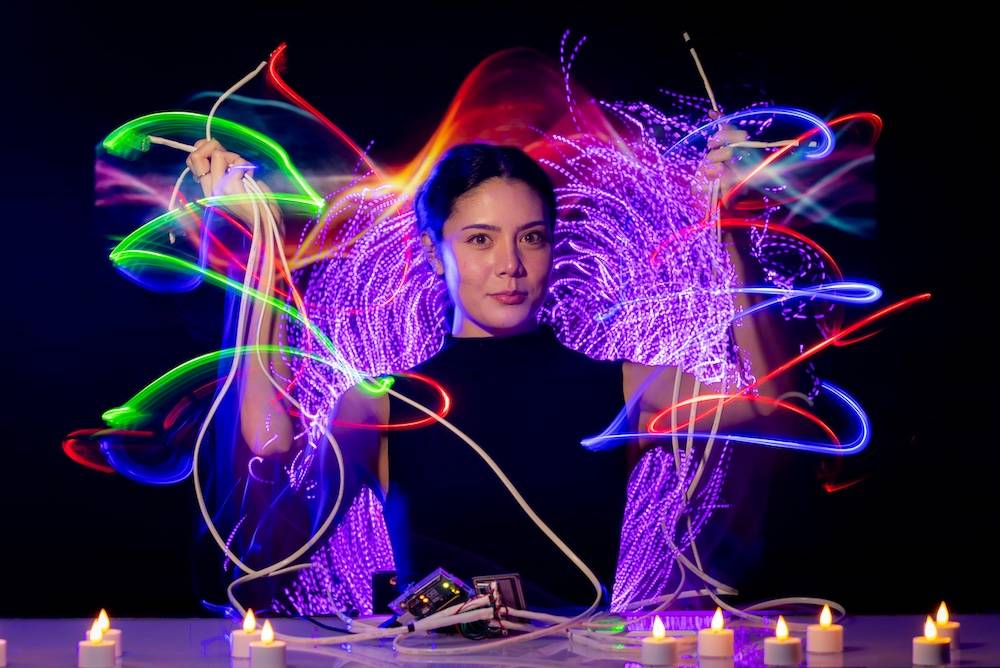
Inventor and SF Achieve Specialist Riley Ferretti is causing a media stir over a device that melds tech and art, capturing light to create organic, ambient music. CNN featured it in their digital media this past summer.
A vocalist and music composer who specializes in complex choral arrangements, with leanings toward the sacred, Ferretti first conceived the invention when she took part in a creative musicians retreat in 2023 that featured a class in building analog synthesizers.
“That ended up producing a screeching sound because of the pitch,” said Ferretti, who has degrees in music composition from the University of Louisville and the University of Florida. “I thought, ‘I want to make this sound a lot more pleasant. How would it sound being filtered through a computer, turning analog into digital?’”
Ferretti said she had no training or real interest in tinkering with tech devices beyond her own computer, “but the workshop gave me the confidence to build out the hardware for a bigger project.”
She built the device — simply called the “Light Instrument” — as part her master’s degree thesis at the University of Florida. It uses open-ended wires (activators) she optimized by hand to collect light input that is translated into electronic information by a microcontroller. A USB port on the circuit board allows her to upload the data to her laptop, where Ferretti created a code to play the ambient sounds like an actual instrument according to her own compositional needs.
“I turned it from analog to digital,” Ferretti said. “I soldered the breadboard myself. All the information goes into my computer, then I choose what to do with it. I can create a melody, choose a pitch, control the volume, make it sound as pretty as I want.”
In its raw form, the device itself resembles a black box, large enough to hold an apple pie, with white wires sticking out of it. What it creates is a harmonious palette of ethereal, ambient sounds of varying dynamics and colors — check out her composition “Moon Dark World” on YouTube — like an orchestra where piccolo and bass are all on the same page. Commenters on Ferretti’s Instagram account, @the.luxlight, have compared it to the sounds of deep space, or the intro to 10cc’s ‘70s hit “I’m Not in Love.”
The music is unconstrained by notation or time signatures, yet with the capacity to be tamed enough to shape or support a composition, within the whims of the light itself. To many, it’s a welcome pushback against the current flood of AI music completely manufactured through synthetic creation.
“Creating the Light Instrument has definitely changed my opinion about what I do,” Ferretti said, noting that one of her graduate school faculty was an AI music professor. “This was when AI was just used as a tool, not as a creation in itself. I’m leaning toward the human side of it — using technology to assist me. I used to see technology as an equal, where the creation was just as important as the creator. But I did make it, and I control how it works.”
Ferretti said she’s hopeful that the prototype could eventually turn into a commercially viable apparatus that could give aspiring composers — or just hobbyists who want to stimulate both hemispheres of their brain — a useful tool to rage against the dying of the light of imperfect human creativity in a world dominated by algorithms.